The Low-Rank Structure of VLA
Reinforcement Learning
Graduate School of Data Science, Seoul National University
TL;DR
Reinforcement learning (RL) concentrates low-rank updates in the Timestep Modules of the flow-based vision-language-action (VLA) models we study. These modules account for a disproportionate share of the RL gains. We trace the low-rank structure to training at discrete denoising timesteps. Projections onto the learned shift directions predict episode outcomes, while similarities between these directions correlate with cross-task transfer. Steering along them further improves trained policies.
What is this paper about?
We study where and how RL learning signals are encoded in VLA parameters. We analyze π0.5 and GR00T N1.5/N1.6 on LIBERO, ManiSkill, MetaWorld, and CALVIN, and use controlled module replacement to test which parameter updates account for the performance gains.
Our analysis links much of RL adaptation to timestep-specific vectors that modulate the action expert’s hidden states. We show that training at discrete denoising timesteps produces low-rank updates to the modules that generate these vectors. We then examine what the shift directions encode through episode-outcome prediction and cross-task transfer analysis, and use them to steer trained policies.
What are Timestep Modules?
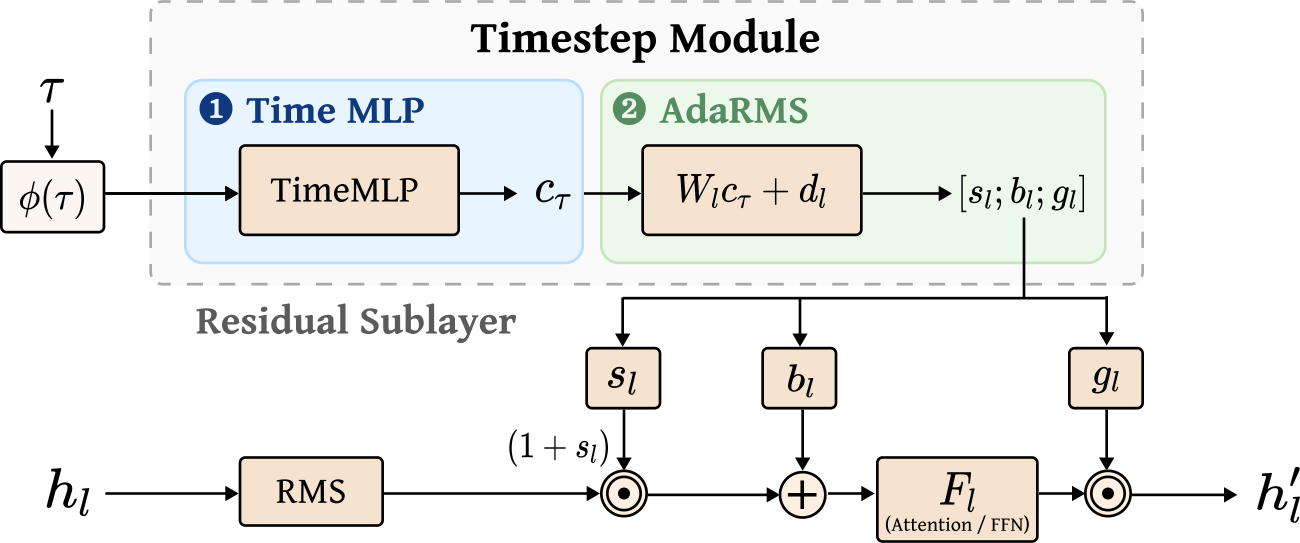
In π0.5, the Time MLP and adaptive RMS normalization (AdaRMS) projections map the denoising timestep to scale, shift, and gate vectors for each attention or feed-forward sublayer. These vectors depend only on the timestep, so they are independent of the image, language instruction, and current task progress.
Where are the RL updates concentrated?
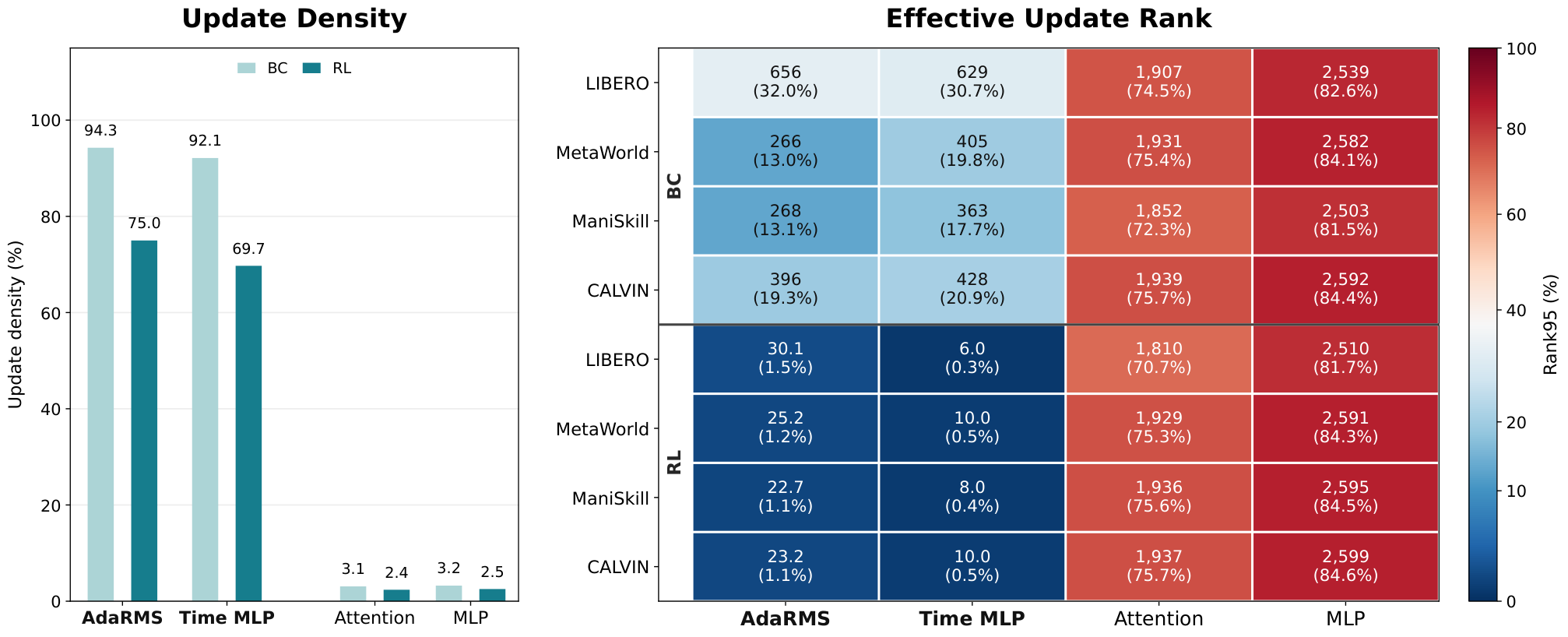
Both behavior cloning (BC) and RL change a larger fraction of parameters in the Timestep Modules than in attention and MLP layers. However, in π0.5, the RL updates to the Timestep Modules have an effective rank of about 6–30, compared with hundreds for BC. RL updates to attention and MLP layers remain high-rank.
Do these updates account for the performance gains?
To test which updates contribute to performance, we retain either the Timestep Module updates or the attention and MLP updates, restoring all other parameters to the base checkpoint. In π0.5, the Timestep Module updates alone recover nearly all of the RL performance across four benchmarks. GR00T N1.5 retains a smaller fraction of the gain.
| Model / benchmark | Base | RL | Timestep Modules only | MLP + Attention only |
|---|---|---|---|---|
| π0.5 / LIBERO | 87.7 | 96.5 | 95.1 | 90.5 |
| π0.5 / ManiSkill | 42.2 | 89.1 | 87.5 | 49.4 |
| π0.5 / MetaWorld | 42.8 | 69.2 | 69.6 | 54.6 |
| π0.5 / CALVIN | 61.8 | 87.7 | 87.0 | 62.7 |
| GR00T N1.5 / LIBERO | 54.4 | 90.3 | 61.3 | 57.9 |
| GR00T N1.6 / LIBERO-Spatial | 75.6 | 85.0 | 84.8 | 84.6 |
“Only” specifies which RL updates are retained; all other parameters are restored to the base checkpoint. LIBERO averages Spatial, Object, and Goal, except for GR00T N1.6. Table 1
Why are the updates low-rank?
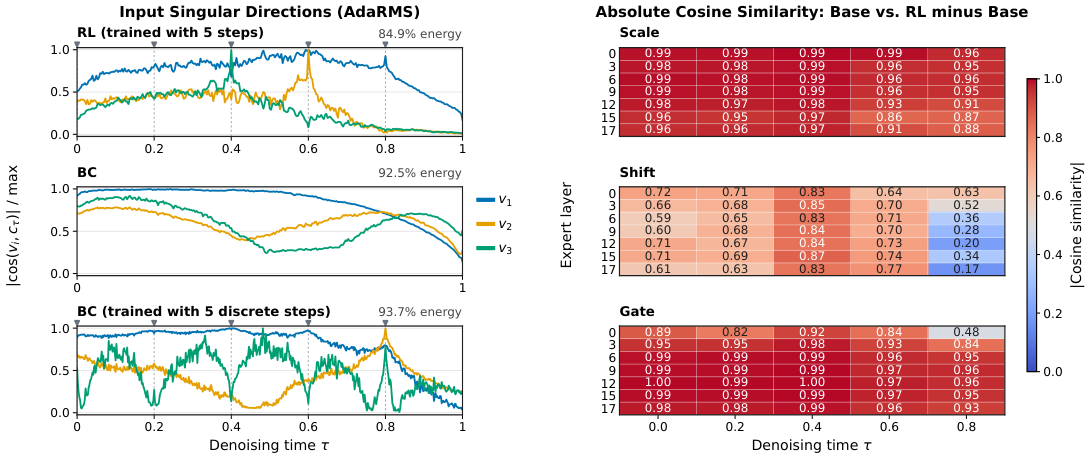
Standard BC samples continuous denoising timesteps, while RL trains at the discrete timesteps used during rollouts. In π0.5, the Timestep Modules become specialized to these discrete inputs. BC trained at discrete timesteps shows similar specialization and low-rank updates. This control links the low-rank structure to the timestep schedule.
What do the shift directions encode?
Why focus on shift vectors?
Scale and gate updates largely align with their base outputs and rescale existing directions. Shift updates are less aligned and change the direction of the vector added to the hidden states. We therefore examine what information these shift directions encode.
Episode outcomes
To test whether shift directions encode episode outcomes, we project the input hidden states at each sublayer–timestep pair onto its shift update, Δb = bRL − bbase, and average the projection scores over each episode. A regularized logistic regression probe combines the scores across sublayers and timesteps to predict success or failure.
We split tasks 70:30 within each benchmark and evaluate the probes on held-out tasks for both base and RL π0.5 policies. For the base policy, ROC-AUC reaches 99.6% on LIBERO-Spatial and ManiSkill. The scores vary across benchmarks and policies.
| Benchmark | Base policy | RL policy |
|---|---|---|
| LIBERO-Spatial | 99.6 | 96.6 |
| LIBERO-Object | 98.6 | 97.4 |
| LIBERO-Goal | 98.9 | 68.0 |
| ManiSkill | 99.6 | 98.3 |
| MetaWorld | 74.2 | 90.1 |
ROC-AUC measures prediction of episode outcomes, not policy success rate. Table 2
Shuffled-label controls
Probes trained with shuffled outcome labels yield near-chance ROC-AUC.
| Benchmark | Base policy | RL policy |
|---|---|---|
| LIBERO-Spatial | 46.5 ± 4.0 | 51.5 ± 3.9 |
| LIBERO-Object | 53.4 ± 6.3 | 47.2 ± 13.3 |
| LIBERO-Goal | 49.0 ± 3.5 | 52.6 ± 6.4 |
| ManiSkill | 51.8 ± 7.0 | 46.5 ± 9.3 |
| MetaWorld | 49.4 ± 4.8 | 49.4 ± 6.1 |
Relationships between tasks
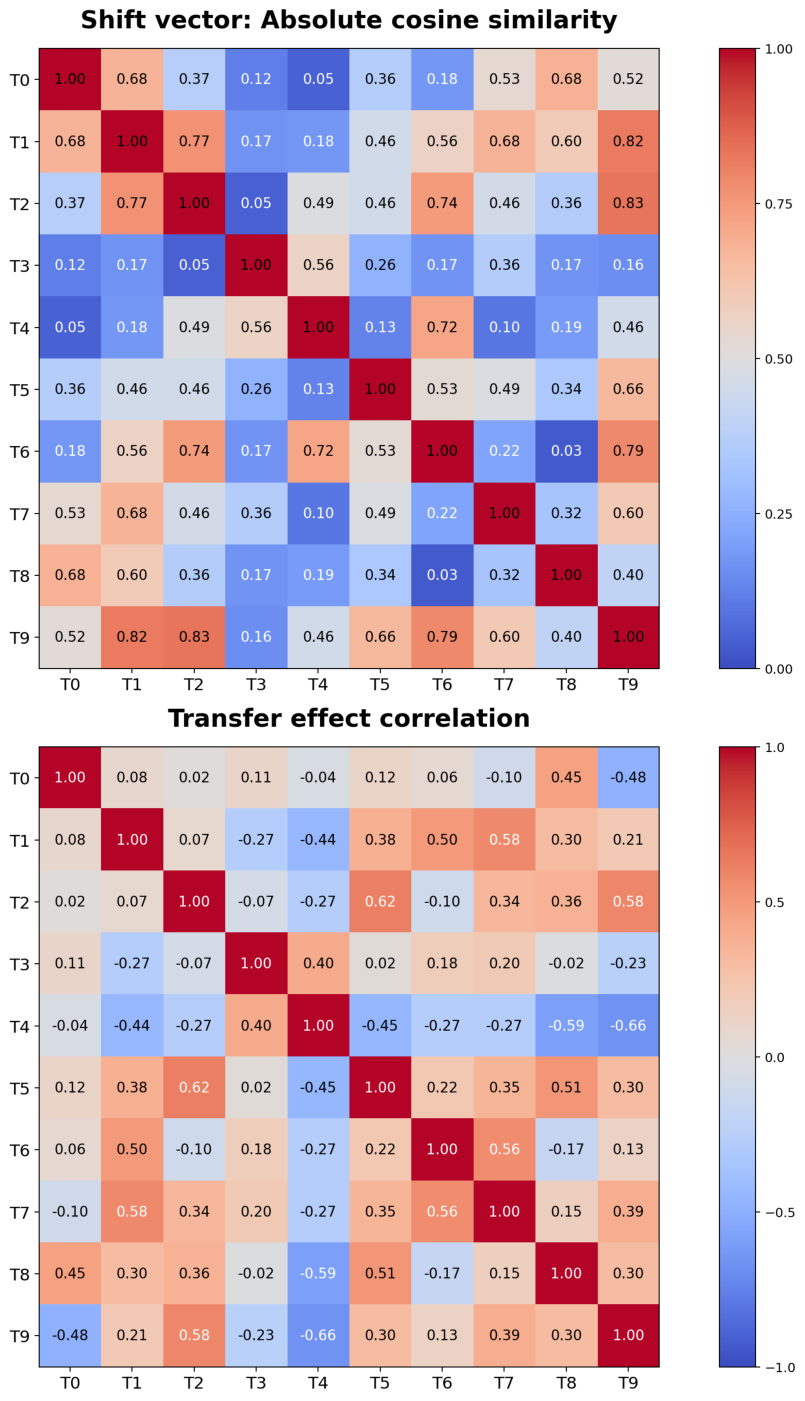
To examine task relationships, we train ten separate π0.5 policies on individual LIBERO-Spatial tasks. Tasks with similar shift-update directions tend to have similar cross-task transfer patterns. The task-wise Spearman correlation between the two similarity profiles averages 0.504 and ranges from 0.224 to 0.794.
Steering an already trained policy
We use the learned shift directions to steer an RL-trained policy. Probing performance on the training tasks determines which sublayer–timestep pair to use. At that pair, we move the hidden states along the shift direction by the minimum amount needed to bring their projection to the successful-episode mean.
Steering improves the RL π0.5 policy's success rate by 2.0–4.0 percentage points across five benchmarks and outperforms matched-norm random directions. The probes and successful-episode statistics come from the training split; steering requires no additional RL training.
| Benchmark | RL | Random steering | Shift steering | Gain (pp) |
|---|---|---|---|---|
| LIBERO-Spatial | 86.7 | 87.2 ± 0.3 | 90.0 | +3.3 |
| LIBERO-Object | 94.7 | 94.7 ± 0.0 | 96.7 | +2.0 |
| LIBERO-Goal | 90.7 | 90.7 ± 0.0 | 94.7 | +4.0 |
| ManiSkill | 90.0 | 88.4 ± 3.4 | 92.0 | +2.0 |
| MetaWorld | 66.7 | 64.1 ± 1.8 | 68.7 | +2.0 |
Evaluated on the 30% held-out task split used for probing. Gains are percentage-point differences from the RL policy. Table 3
BibTeX
@article{oh2026low,
  title={The Low-Rank Structure of VLA Reinforcement Learning},
  author={Oh, Minjae and Park, Yoonah and Lim, Jongwon and Jo, Yohan},
  journal={arXiv preprint arXiv:2609.34599},
  year={2026}
}