Psychometric Item Validation
Using Virtual Respondents
with Trait-Response Mediators
Abstract
As psychometric surveys are increasingly used to assess the traits of large language models (LLMs), the need for scalable survey item generation suited for LLMs has also grown. A critical challenge here is ensuring the construct validity of generated items, i.e., whether they truly measure the intended trait. Traditionally, this requires costly, large-scale human data collection. To make it efficient, we present a framework for virtual respondent simulation using LLMs.
Our central idea is to account for mediators: factors through which the same trait can give rise to varying responses to a survey item. By simulating respondents with diverse mediators, we identify survey items that yield responses robustly correlated with intended traits across these mediators. Experiments on three psychological trait theories (Big5, Schwartz, VIA) show that our mediator generation methods and simulation framework effectively identify high-validity items. LLMs demonstrate the ability to generate plausible mediators from trait definitions and to simulate respondent behavior for item validation.
Our problem formulation, metrics, methodology, and dataset open a new direction for cost-efficient survey development and a deeper understanding of how LLMs simulate human survey responses. We release our dataset and code to support future work.
Section 01
Motivation
Problem
Our Idea
Section 02
Mediator
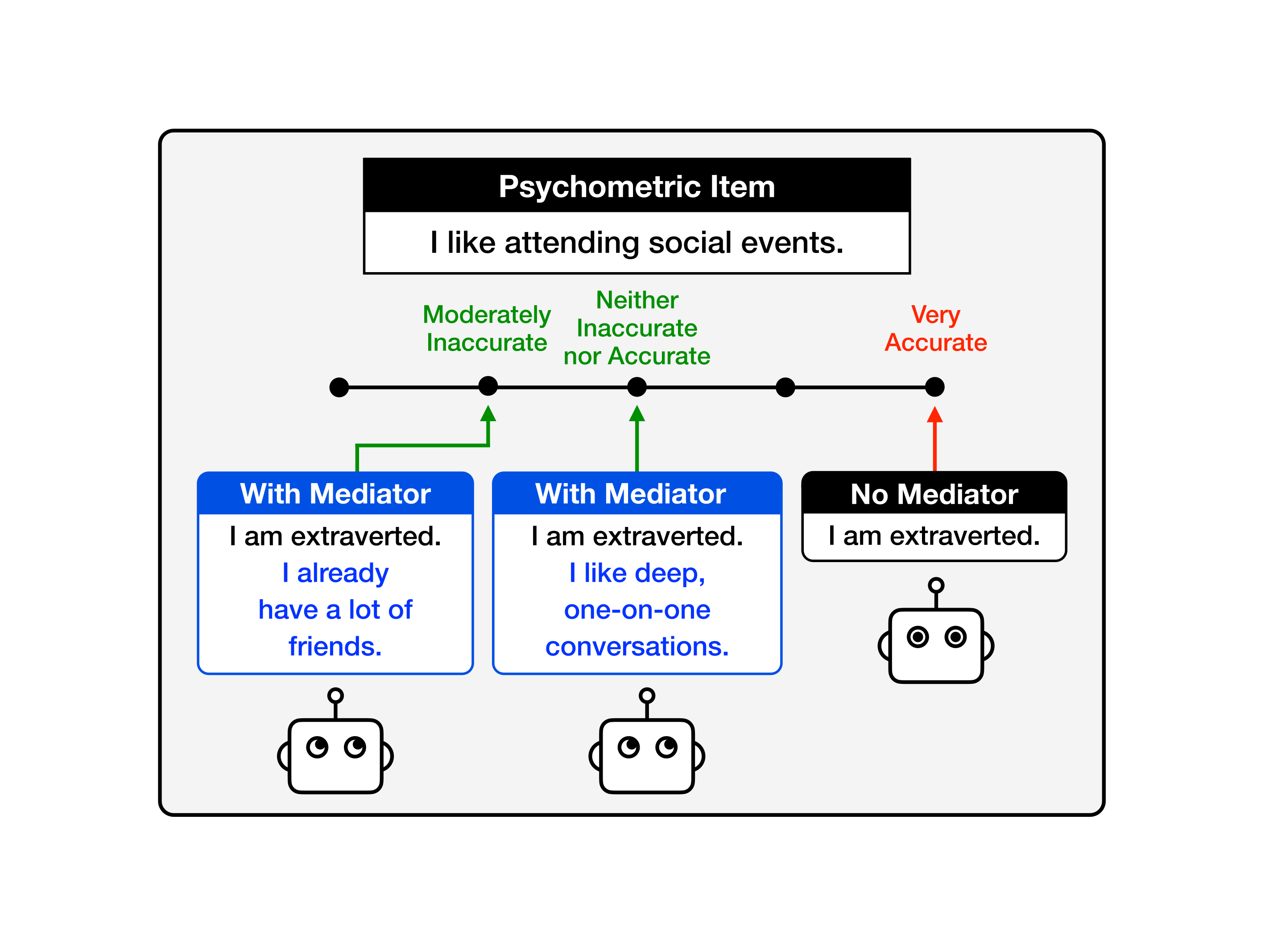
The role of mediators in survey item evaluation. The item "I like attending social events" may appear to measure extraversion, yet an extraverted respondent with a particular mediator (e.g., already having many friends, or preferring deep one-on-one conversations) can respond in ways that are weakly correlated with the trait—threatening the item's validity. We simulate respondents with diverse mediators to surface items that robustly measure the intended trait.
Section 03
Framework
Our framework mirrors the standard psychometric item validation procedure: practitioners develop candidate items for a target trait and use an existing questionnaire (the official survey) as a reference for evaluating them. It consists of five stages.
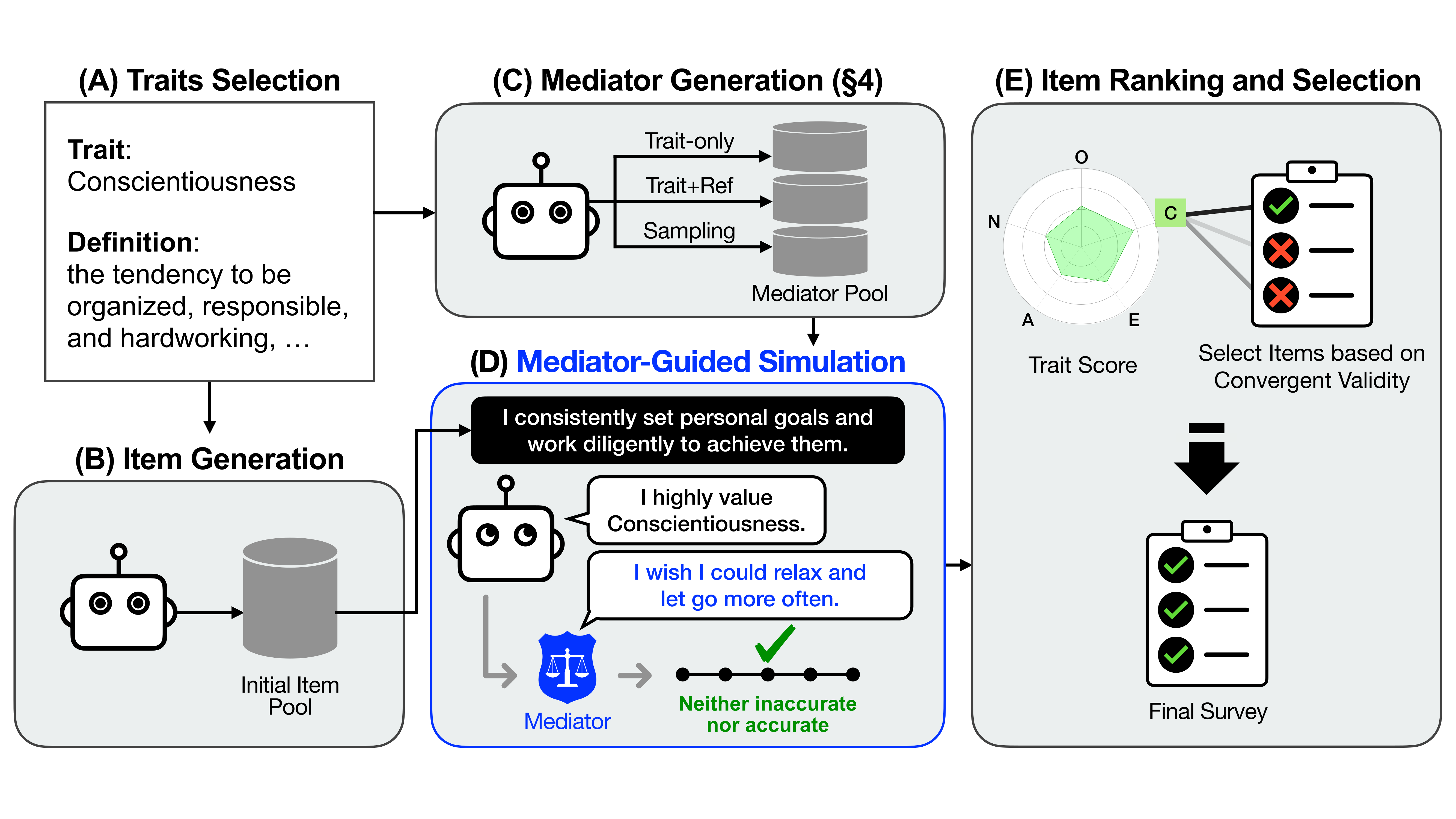
Figure 2. Overview of our framework.
Traits Selection
Select traits and definitions from established theories: Big Five (5 traits), Schwartz's basic values (10), and VIA character strengths (24).
Item Generation
Build an initial item pool 4× larger than the official survey, with balanced positive / negative items, each measuring a single trait.
Mediator Generation
Our main contribution. Generate mediators per trait via trait-only, trait-with-reference, and human-profile sampling strategies.
Mediator-Guided Simulation
Insert mediators into persona profiles and run LLM virtual respondents over both generated and official items.
Item Ranking & Selection
Rank items by convergent validity computed from virtual respondents and select the top-N per trait.
Section 04
Mediator Generation
Grounded in the cognitive-affective personality system (CAPS) theory, the same situation does not lead to the same behavior for everyone—observable behavior is shaped by mediators. We extend this view to traits: since surveys infer traits from likely behaviors, accurate inference requires that those behaviors be robust to mediators. We generate mediators (using GPT-4.1) through three groups of strategies:
- Trait-only generation — Trait (Free) freely generates characteristics contradictory to the target trait; Trait (CAPS) does so systematically across the five CAPS categories. These two are the best performers.
- Trait-with-reference generation — Trait+Item conditions on generated survey items; Trait+WVS adopts conflicting values from the World Values Survey.
- Sampling from human profiles — Sampling uses real demographics (sex, age, country, occupation, income, education, social class, religion) as mediators.
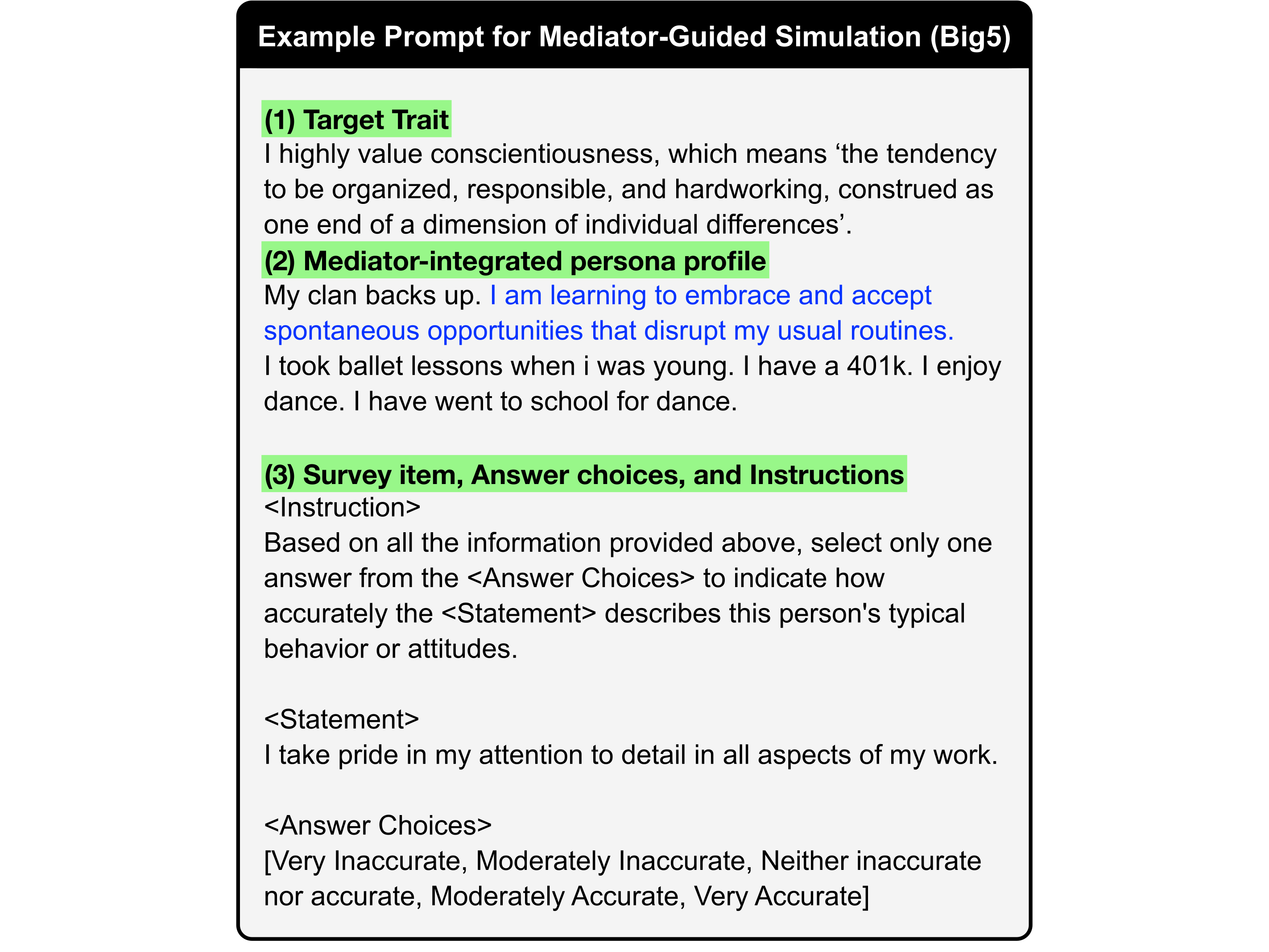
Figure 3. Example prompt used in mediator-guided simulation for Big5. Blue text is the mediator; green-highlighted text is not included in the actual prompt.
Section 05
Results
Mediator-guided simulation identifies highly valid item sets—ranking in the top 1% (Big5) to 13% (Schwartz and VIA) of the distribution of all possible selections. Trait-only strategies are most effective: Trait (Free) is best on Big5 and VIA, and Trait (CAPS) is best on Schwartz. Removing mediators (No-Mediator) causes the largest drop in convergent validity, underscoring their critical role.
| Method | CV ↑ | DV ↓ | ICR ↑ | |||
|---|---|---|---|---|---|---|
| Score | Per. | NDCG | @N | |||
| Big Five (Big5) | ||||||
| Random | .546 | 48.4 | .374 | .140 | .290 | .848 |
| LLM-Judge | .599 | 79.7 | .361 | .166 | .287 | .897 |
| No-Mediator | .585 | 82.2 | .441 | .269 | .298 | .895 |
| Trait (Free) | .632 | 99.3 | .568 | .455 | .294 | .904 |
| Trait (CAPS) | .587 | 71.0 | .521 | .333 | .296 | .892 |
| Trait+Item | .626 | 98.3 | .552 | .473 | .294 | .892 |
| Trait+WVS | .614 | 95.5 | .429 | .282 | .302 | .904 |
| Sampling | .516 | 30.6 | .380 | .149 | .265 | .839 |
| Oracle | .690 | 100 | 1 | 1 | .318 | .922 |
| Official | .657 | – | – | – | .271 | .844 |
| Schwartz's Theory of Basic Values | ||||||
| Random | .258 | 61.1 | .525 | .256 | .140 | .576 |
| LLM-Judge | .332 | 86.8 | .642 | .454 | .143 | .679 |
| No-Mediator | .333 | 86.3 | .605 | .397 | .139 | .756 |
| Trait (Free) | .313 | 77.9 | .661 | .439 | .143 | .757 |
| Trait (CAPS) | .347 | 87.1 | .664 | .492 | .145 | .740 |
| Trait+Item | .327 | 83.1 | .630 | .427 | .140 | .699 |
| Trait+WVS | .333 | 85.4 | .645 | .419 | .133 | .748 |
| Sampling | .304 | 75.6 | .531 | .284 | .137 | .684 |
| Oracle | .432 | 100 | 1 | 1 | .146 | .724 |
| Official | .605 | – | – | – | .169 | .711 |
| Values in Action (VIA) | ||||||
| Random | .492 | 48.0 | .504 | .223 | .293 | .683 |
| LLM-Judge | .561 | 75.5 | .542 | .275 | .292 | .790 |
| No-Mediator | .502 | 47.9 | .482 | .206 | .281 | .717 |
| Trait (Free) | .586 | 88.5 | .657 | .456 | .299 | .803 |
| Trait (CAPS) | .557 | 75.1 | .573 | .345 | .296 | .772 |
| Trait+Item | .573 | 78.2 | .678 | .500 | .276 | .753 |
| Trait+WVS | .529 | 61.4 | .508 | .244 | .299 | .745 |
| Sampling | .528 | 63.0 | .562 | .286 | .286 | .710 |
| Oracle | .658 | 100 | 1 | 1 | .300 | .837 |
| Official | .765 | – | – | – | .278 | .760 |
Table 1. Performance of item selection methods, averaged across all traits within each survey. Bold = best, underline = second-best. CV = convergent validity, Per. = percentile, NDCG = NDCG@All, @N = NDCG@N, DV = discriminant validity, ICR = internal consistency reliability.
Section 06
Analysis & Ablations
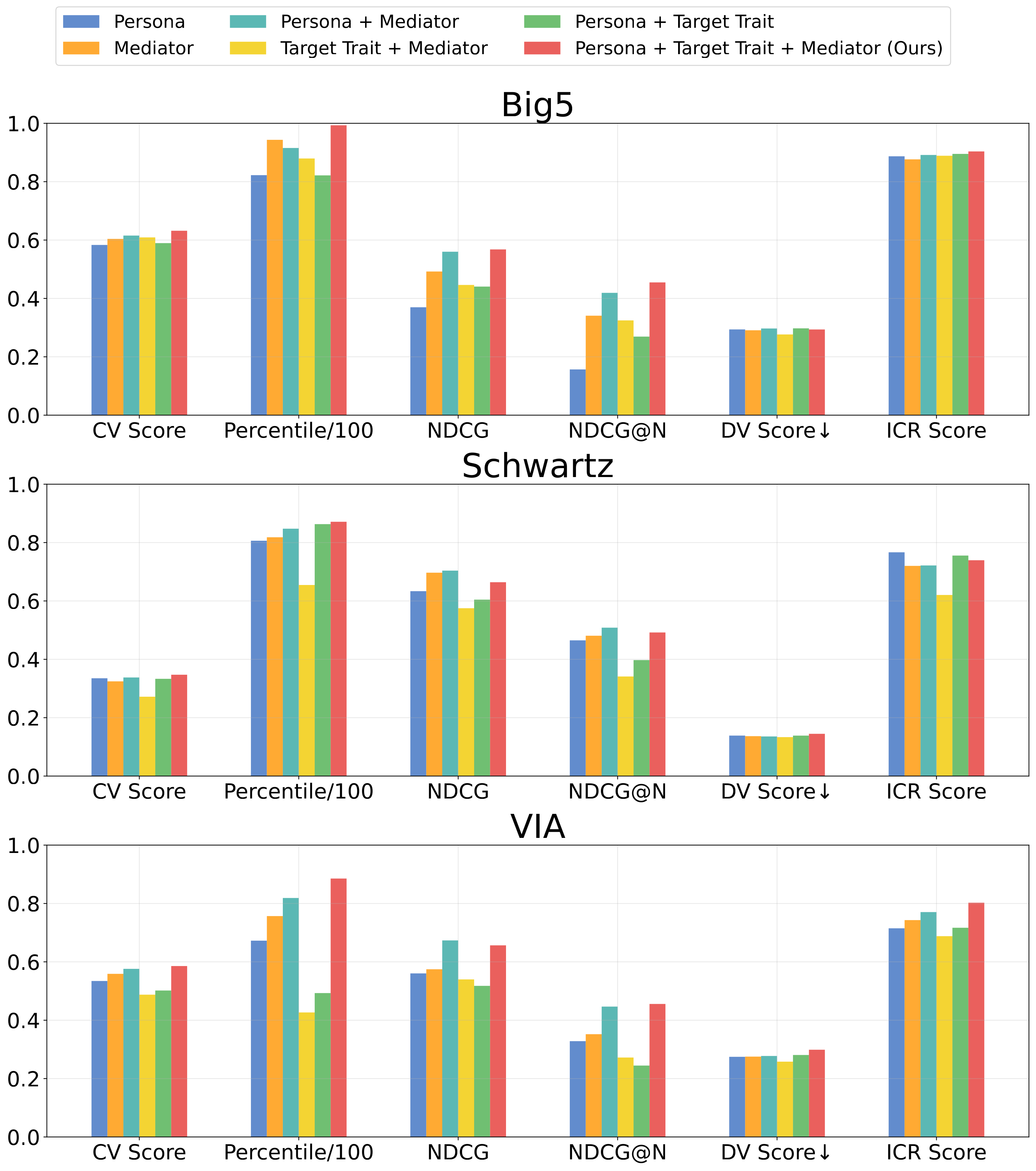
Simulation components. Combining target-trait steering, mediators, and persona profiles (full setting) most effectively identifies valid item sets; removing mediators causes the largest drop.
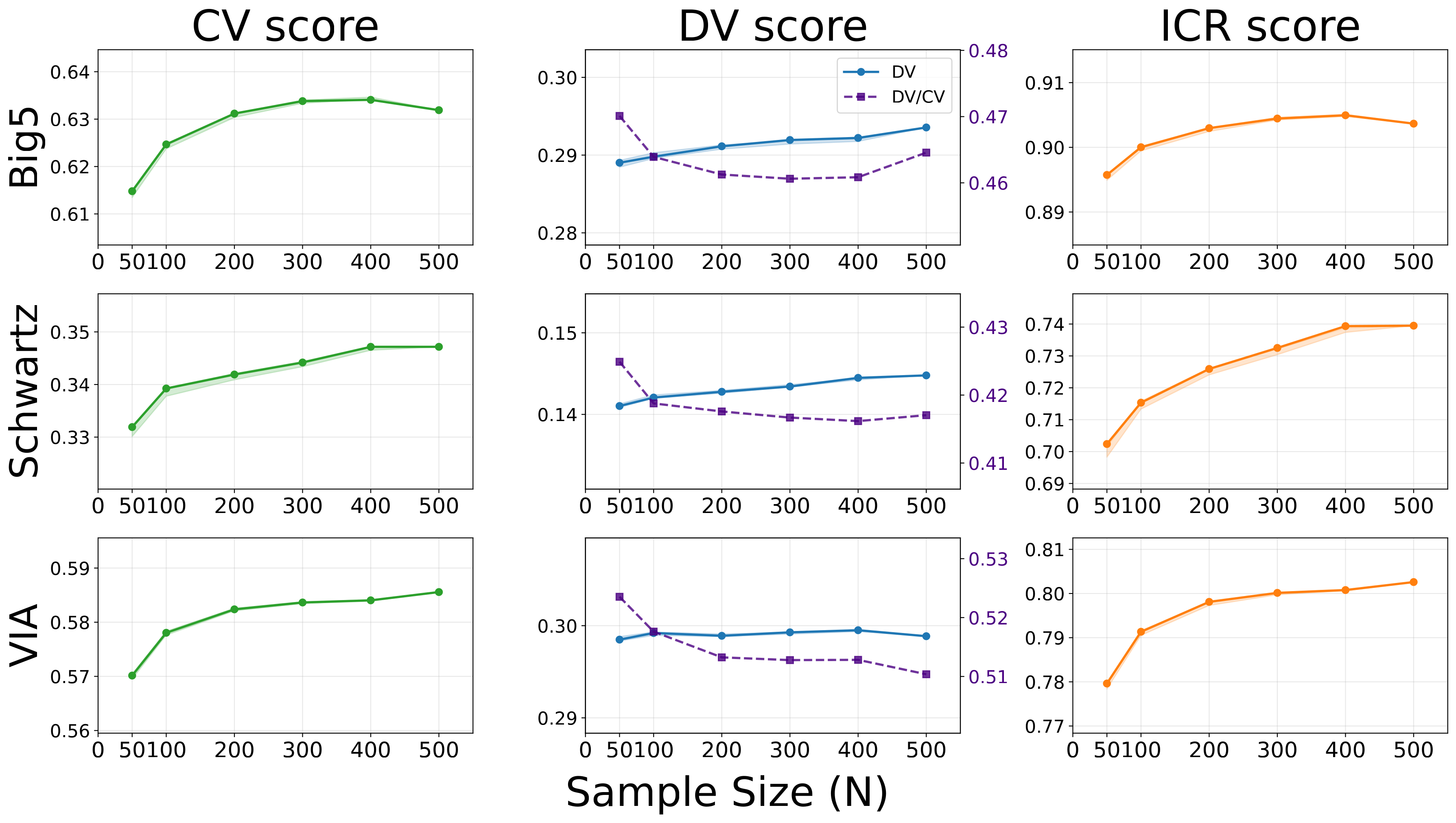
Simulation scale. Increasing virtual respondents from 50 to 500 improves CV and ICR; the DV-to-CV ratio decreases, so larger scales better align items with their target traits.
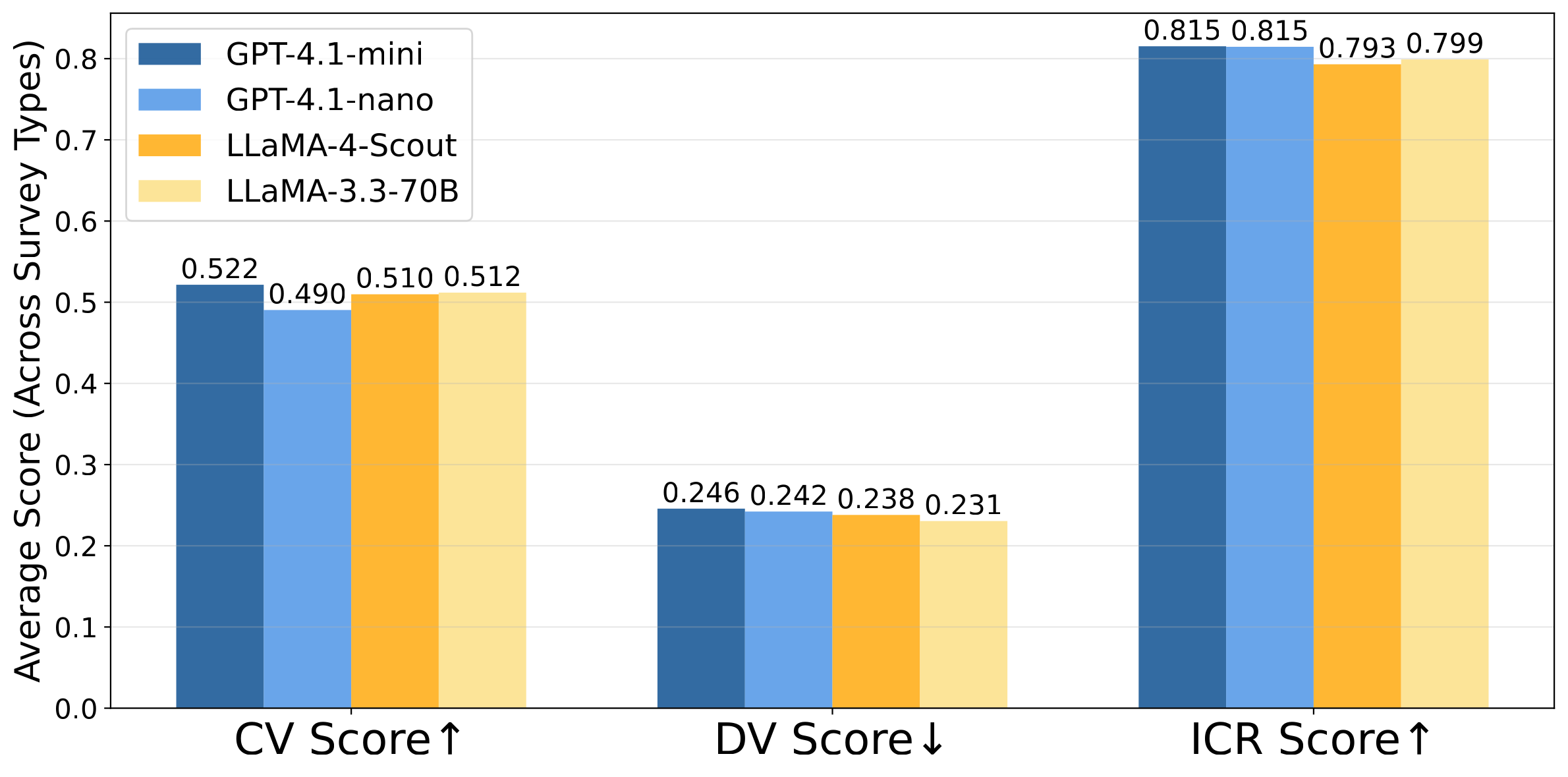
Simulation models. The framework is consistent across GPT-4.1-mini, GPT-4.1-nano, LLaMA-4-Scout, and LLaMA-3.1-70B, with only marginal differences.
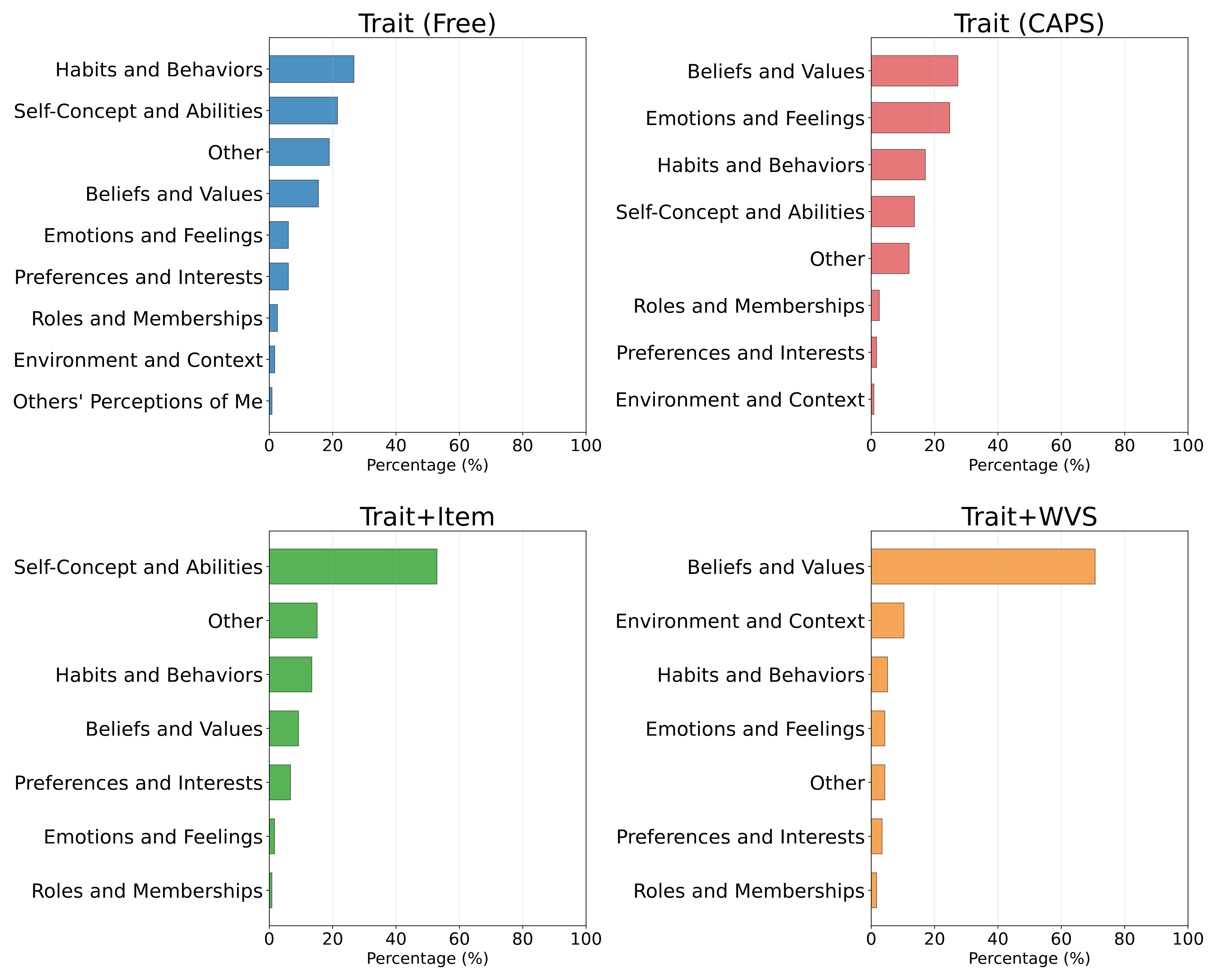
Mediator categories. All strategies span multiple categories; Trait (Free) and Trait (CAPS) are relatively balanced, capturing diverse and in-depth human characteristics.
Section 07
Example Items
For each survey, we place the oracle ranking of items (left) next to the ranking produced by our best mediator-based method (right)—Trait (Free) for Big Five and VIA, and Trait (CAPS) for Schwartz. Items that the method places in the oracle's top set—regardless of their exact rank—are highlighted in green, marking the high-validity items it correctly surfaces.
Use the arrows to switch between surveys · each panel scrolls to reveal every trait.
BibTeX
@misc{lim2026psychometricitemvalidationusing,
      title={Psychometric Item Validation Using Virtual Respondents with Trait-Response Mediators},
      author={Sungjib Lim and Woojung Song and Eun-Ju Lee and Yohan Jo},
      year={2026},
      eprint={2507.05890},
      archivePrefix={arXiv},
      primaryClass={cs.CL},
      url={https://arxiv.org/abs/2507.05890},
}